| Term | Meaning | Usage |
|---|---|---|
| Ashi | foot | |
| Ashikatana | footblade | Tobi ashikatana geri |
| Ato | behind | Hije no ato tsuki |
| Barai | sweep away | Gedan barai seiken tsuki |
| Bubishi | manual of military preparations | |
| Budoka | one who resolves conflict | |
| Bushi Matsumura | Bubishi: the Bible of Karate | |
| Chinto | ||
| Choki Motobu | ||
| Choku | direct, straight | Gedan barai go den choku tsuki |
| Chotoku Kyan | ||
| Chudan | middle level | Chudan uke seiken tsuki Dashi |
| Empi | elbow | Wansu Kata Empi [Shotokan] |
| Gedan | low level | Gedan barai seiken tsuki |
| Geri | kick | |
| Go Den | five ?den? | Chudan uke go den choku tsuki |
| Gojo Ryu | school of Karate founded by Miyagi Chojun | |
| Gyaku | reverse, opposite | Seiken Gyaku Tsuki |
| Hanshi | master teacher, model scholar | Hanshi Willie Adams |
| Hidari | left | |
| Hije | elbow | Hije no ato tsuki |
| Hiza | knee | |
| Ibuki | breath, breathing | |
| Ippon | one point (in a contest) | Judo win |
| Ippon Kumite | one form sparing | |
| Ippon Nukite | one finger spear hand | "Eye like ping pong ball." |
| Isshinryu | One heart way | |
| Jōdan | upper level | Jodan gyaku tsuki |
| Kara | Chinese | karate (Chinese hand) |
| Karate | empty hand; Chinese hand | Karate |
| Karate Dō | modern martial way derived from karate jutsu (techniques) [empty hand way] | Isshinryu Karate |
| Karateka | karate expert | Kyoshi Joslin's dan students |
| Kiai | spirit shout; unification of mind and body with a focused shout originating from the lower abdomen [spirit unification] | |
| Kiai Dori | hypnotism; spirit seizing techniques | Kiai |
| Kin | gold, testicles | Kin Geri |
| Ki o tsuke | attention, watch out | |
| Konate | Mae Konate | |
| Kumite | sparring | |
| Kusanku | ||
| Kyōshi | teacher [doctrinal teacher] | Kyoshi Joslin |
| Mawashi | turn, go around | Mawashi geri (roundhouse kick) |
| Mae | front; before; ago | Mae Geri |
| Mawari | turn, go around | Mawari geri (roundhouse kick) |
| Migi | right | |
| Naihan | ||
| Naihanchin [Okinawan] Naihansen [Japanese] | fighting on a levee | |
| Naihanchi Dashi | iron horse stance | |
| Neki Dachi | cat stance | |
| Nukite | spear hand | Tegata Barai Nukite |
| Oi | lunge | implies pursuit: oi tsuki or oi uchi are attacks where you're really going after your opponent |
| Otoshi | drop; trap door; throw, throw down | Otoshi Geri |
| O-Uchi | ??? | O-Uchi O-Uchi |
| Rei | bow, courtesy, appreciation, remuneration, return present | |
| Renshi | instructor [drill instructor] | Renshi Bennati |
| Ryō | both; two | Ryo Ashi Geri |
| Ryu | style, school, system | Issinryu |
| Sanchin | three conflicts, mind/body/chi | |
| Sanchin Dachi [Okinawian] | hourglass stance | |
| Seiken | regular fist | Seiken oi Tsuki |
| Seiken Tsuki | thrust with regular fist | Jodan Uke Seiken Tsuki |
| Seisan | thirteen | |
| Seiuchin Kata | war kata, the storm within the calm, the lull in the storm, | |
| Sensei | teacher | |
| Shiai | competition | |
| Shorin-Ryu | ||
| Shotokan | ||
| Shuri Okinawa | ||
| Shutō | hand blade | Shuto Uchi Shuto Uchi |
| Soba | ???side??? | Soba Konate |
| Sokutō | outer edge of foot [foot blade] | Sokuto Geri |
| Tatsuo Shimabuku | ||
| Te | hand, arm; trick; skill | Tegatana, Te Waza, karate |
| Tegatana | hand blade | Tegata barai nukite |
| Tobi | fly, skip, jump; spring up | Mae Tobi Geri |
| Tomari Okinawa | ||
| Tonbo | dragonfly | Tonbo Geri |
| Tori | hold, capture; performer | katate tori; tori attacks |
| Tsuki (Zuki) | thrust, poke, strike | |
| Uchi | [depends on kanji] attack; inside, within, among; strike, hit, beat | O-Uchi O-Uchi, Uchi Gama |
| Uke | receive, accept; block; parry | uke defends; gedon uke seiken tsuki |
| Uki | float | Uki Otoshi |
| Ura | back, reverse, palm, sole | Ura uchi seiken tsuki |
| Uraken | backfist | Seiuchin Kata, Naihanchi Kata |
| Ushiro | rear, behind, back | Mae Geri Ushiro Geri |
| Wansu | Wansu Kata | |
| Wasa | art, technique, performance | Shime wasa, Henka wasa |
| Yoko | side | yoko geri |
| Zarei | bow while sitting | |
| Zanshin | remaining mind | |
| Zenkutsu | leaning forward | Zenkutsu Dachi |
| Zenkutsu Dachi | forward stance | Zenkutsu Dachi |
Showing posts with label Karate. Show all posts
Showing posts with label Karate. Show all posts
Wednesday, April 1, 2020
Karate Glossary

Friday, December 24, 2010
Sanchin Kata
Sanchin literally translates to the three conflicts (traditional Chinese medicine): mind, body, and spirit (breath/Chi). Sanchin Kata teaches us how to unite the three conflicts into one indestructible karateka. We learn to reduce the conflicts and harmonize the mind, spirit and body.
Sanchin is an isokenetic exercise, it uses dynamic tension and ibuki breath as in Seiuchin Kata. The training reminds me of my Jujitsu practice of hitting my rock and pounding the body after cultivating the Qi. There is a lot of stuff going on in the kata that requires the study of Traditional Chinese Medicine (TCM) and guidance of a knowledgeable sensei.
(Remind me to get back to the Bubishi.)
Prof. Jenkin's Martial Arts Dictionary tells us that the Japanese word sansen, three conflicts, is pronounced "sanchin" in Okinawa and that sansen dachi is the hourglass stance (pronounced "sanchin dachi" in Okinawa.) Does the hourglass (saam chien) stance get its name from the old Chinese quan or is Saam Chien (Sanchin) named after the stance?
The following links are not recommendations, just things I found that are at least somewhat informative. The information about Traditional Chinese Medicine in some of these links is not at all accurate (writers are not TCM practitioners.)
- Sanchin - the three conflicts. Blog post by someone who actually practices the kata and studied with a teacher who understood the kata. Good information about how to train using Sanchin Kata.
- Sanchin from a western medical perspective (can not vouch for this article at this time).
- Sanchin kata, three conflicts and three Jewel (part 1)
- Sanchin kata, three conflicts and three Jewel (part 2)
- Shihan John Lehner's email on Sanchin Kata.
- Sanchin Kata history from a Goju Ryu perspective.
- The Five Principles of Sanchin (Author IMHO has a western view point, doesn't get it.)
Thursday, December 16, 2010
Tomari Okinawa
The village of Tomari Okinawa is the home of Wansu Kata and Banssai Kata.
Grand Master Shimabuku, founder of Isshinryu Karate, learned this kata from his teacher Master Chotoku Kyan.
Thursday, December 9, 2010
Chinese Hidden Foot
Kioshi Dave Joslin talked about the use of Chinese Hidden Foot as a defensive technique in tonight's class. In particular, Wansu Kata uses Chinese Hidden Foot to move off the line of attack quickly.
It is quick and turns the body so that a center line attach becomes a glancing blow if it connects at all.
In my Jujitsu training we would traverse the length of the dojo using Chinese Hidden Foot both passing the leg behind and in front. Facing the Shomen through out, moving down to the right and back to the left. Keep the knees bent and the head below the imaginary ceiling fans five feet off the mat. Another cool drill is to move down the line switching from hidden foot to horse stance (by turn 180° on the balls of the feet.)
Sunday, December 5, 2010
Karate in YOUNG JUNIUS
What follows is an insightful description of the mind of a beginning Karate/Kung Fu student, excerpt from Chapter 30 of YOUNG JUNIUS by Seth Harwood.
 I am reading this book on my Kindle and thoroughly enjoying it. (I think the published book is significantly better than the original podcast draft, much tighter story and cleaner descriptions of the world these people live in.) Recommend the book if you like action fiction and enjoyed The Wire series. This book is not for your minivan, so put on your headphones or read the printed word.
He stepped to that side of the roof and launched into his first form, the punch combination that started off the Monkey Sequence. The Monkey was familiar to him but to get to the next level he had to learn the Tiger perfectly so he could test for his purple belt. Purple marked the turning point between know-nothing beginner and respectable mid-level student. He’d been going for close to three months now and was eager to make the jump.
Purple was a dark color, so different from yellow, white, or orange. Just the fact that you had a dark color around your midsection made you look like you were on your way. Dark belts were real.
The Monkey started with a series of punches and then slide-steps with blocks that led to kicks. As Rough started into these, he gradually left his thoughts behind. As he went on, he started to punch harder, kick with more force. His body loosened up.
In ten minutes, he had his jacket off and was practicing the opening of Tiger. It felt good to sweat in the cold wind, to move faster than when he started, to go through the Monkey as fast as he could.
Now just the start of Tiger was his challenge: to go through it clean and as fast as he could. It was just seven punches, four blocks, and three kicks, with steps and changes of direction in between, but it made for enough of a challenge. He ran through the sequence in his head: punches, blocks, kicks.
I am reading this book on my Kindle and thoroughly enjoying it. (I think the published book is significantly better than the original podcast draft, much tighter story and cleaner descriptions of the world these people live in.) Recommend the book if you like action fiction and enjoyed The Wire series. This book is not for your minivan, so put on your headphones or read the printed word. The podcast of the story, printed book and/or eBook versions available at all the usual places and at SethHarwood.com.
Tuesday, November 9, 2010
Naihanchi Kata - Details
The Japanese Martial Arts Character Dictionary by Prof. Thomas R. Jenkins says that "naihanchin" is the Okinawan word for the Japanese word "naihansen", fighting on a levee.
Other Japanese words that seem applicable based on their kanji are:
- Naihan—on a levee
- Nai—inside (first kanji in naihansen)
Saturday, October 16, 2010
Centering
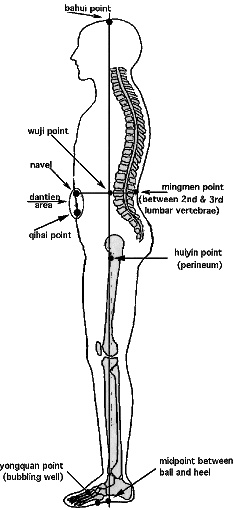 This entry on Centering was created because I realized that when Grand Master Willie Adams used the term he meant something completely different from what I think of when I hear the term Center.
When I talk about center I mean the center of the physical body, the wuji point (click on figure for more information) and connection to the ground. When Hanshi speaks of centering he is speaking of remaining on the center line of attack, not tipping or swaying from side to as you move. The following is what I learned from Hanshi Willie Adams at his seminar down at the dojo last month. (Yes, I wrote things down after the seminar and have been working with the concepts on the mat.) This is my understanding of centering. (The seminar was public and very basic. I can only imagine the significance of centering in Hanshi Adams teachings.)
Centering = Step + Set
- Weight distributed equally between the two feet. Weight on the balls of the feet.
- Head stays on the center line, the line of attack, during a step.
- 10% weight shift during a step.
- Ball of foot skims the ground, toes up.
- During circle step the leg movement covers the groin (45° angle.)
- Weight shifts back to 50/50 before the set (stepping foot plants.)
After digesting the principal of centering and incorporating it with another of Hanshi's ideas, "throwing" a punch/kick, I realized that Isshinryu Karate is primarily a linear system. It gets its speed and effectiveness from direct shortest–distance movements.
Direct force—swiftly applied.
Sunday, October 10, 2010
Effect of Kiai on Perception
Sinnett S, Kingstone A (2010) A Preliminary Investigation Regarding the Effect of Tennis Grunting: Does White Noise During a Tennis Shot Have a Negative Impact on Shot Perception? PLoS ONE 5(10): e13148. doi:10.1371/journal.pone.0013148
Tennis Players' Grunts May Slow Opponents' Reactions: Scientific American Podcast. A recent study shows the negative impact that noise can have when one is attempting to predict where a tennis ball will land.
Duh! Kiai effects people and animals.
Tanju Notes
Notes from Professor Lane's class on Tanju No Maki at the 2010 AJJF Black Belt Weekend, Sonora hosted by Mountain Storm Jujitsu.
- Use the one inch punch; fist, elbow and knee. Particularly useful for the Hibara Hazushi above the elbow.
- No intent. (Exercise: catch house flies with you hand, they sense your intent.)
- If someone is confronting you in this context they need a lesson, break something.
Saturday, September 25, 2010
Isshinryu Breathing
I learned the mechanics of Isshinryu breathing from Hanshi Willie Adams at his seminar down at the dojo today.
Attacks are done with the lungs almost empty.
Always keep at least 10% percent of your breath at all times, don't let the last bit go. You need this remaining air so that your body can continue to function.
Before initiating a move exhale 90% of your air then retain the breath during the move.
A kiai will use 10% of your breath therefore, if the move is going to be preceded by a kiai exhale 80% of the breath, kiai and then execute the move (10% of the vial capacity remains during the move).
The Japanese word for breath or breathing is ibuki. Soft internal breathing is in ibuki. Hard internal breathing is yō ibuki.
Based what I have learned at the dojo and this article in Black Belt Magazine (1966), The Cat, I believe this philosophy of breathing comes primarily from Grand Master Shimabuku's Gojo Ryu lineage. Quoting the article...
There is another form of kata for which the school is famous and without which no explanation of the Goju style would be complete. That is the school's breathing kata. No one who has ever witnessed a Goju man practicing his breathing kata under a full head of steam will ever forget the experience. It is an awesome and, to those of a more timid turn, sometimes frightening experience. A good Goju man can be heard half a block away and more while engaged in breathing exercises.There are two types of breathing practiced, the in-ibuki and the yo-ibuki. The in-ibuki is the soft but firm type of breathing which starts from deep within the abdomen. This is similar to the type of breathing which is practiced in Yoga and Zen meditation, and is usually directed towards spiritual and meditative matters when practiced. Goju adherents never tire of repeating that this is the normal way a baby breathes. It is only when we get older that we learn to breathe from our chest.
The yo-ibuki is the hard style of breathing. The sound effects are menacing. The breathing is loud and heavy and comes from deep within, producing something of the sound of a full-throated lion about to strike. The inhaling is done in quick intakes through the nose while the exhaling is a prolonged process of short breaths through the mouth. In exhaling the whole body is tensed, including the throat and esophagus. This tightens the air passage and the air is forced from the abdomen. This whole process is said to be combative or animal-like breathing.
The tensing that is carried out during the breathing exercises is similar to that carried on in dynamic tension and isometric exercises. Tensing is believed to build up physical strength. And that goes internally, too, where the breathing is said to strengthen the heart and other vital organs. The student is taught never to exhale all his breath at once but to ration it out in short breaths. One reason is to always save a little breath so that an opponent cannot strike when one is out of breath and at one's weakest just before inhaling. The idea is always to save a little breath to counter. A good Goju man who is really warmed up will stride across the floor rippling every muscle from head to foot while engaged in powerful animal-like breathing. The effect can be quite spectacular.
But there is another side to the breathing exercises, the side concerned with the mental and spiritual aspects of karate. By its very nature, this is the side most difficult to grasp for many persons, especially Westerners. The most advanced type of breathing exercise is that in which all of one's strength is concentrated on a specific feeling or thought. It is through concentration and meditation that man learns to improve himself.
Isshinryu Methodology
I learned the basic methodology of Isshinryu Karate from Hanshi Willie Adams at his seminar down at the dojo today.
- Centering
- Breath Out
- Stance
- Throw Attack
Breath Out—Attack with only 10% of your vital capacity remaining.
Stance—Weight on balls of feet, toes down, knees bent, Seisan stance
Throw Attack—Prepare the weapon, launch and let if fly, relaxed until impact, accelerate the last 12 inches.
Throw Attach Details
- Prepare the weapon before the attack. (Stupid to walk into a battle before you assemble and load your gun.)
- Move straight from chambered position to the target. No twisting, looping, dipping, hooking or hesitation.
- Twelve inches before the target accelerate the weapon through the target.
- One inch before the target integrate the fist with the frame into the ground.
- Connect the frame to the ground at the point of impact, Yang:
- Rear foot then
- Lead foot, then
- Rear fist, then
- just before contact lead fist.
- Disengaging from the attack and inhale (at any point you are able to reengage by reversing process), Yin:
- Relax lead fist, then
- Relax rear fist, then
- Relax lead foot, then
- Relax rear foot.
Friday, February 26, 2010
Uraken, the backfist

Uraken is the name of the backfist strike. The illustration shows the impact area of the fist when Uraken is delivered, the proximal side of the first knuckles of the index and middle fingers.
Seiuchin Kata and Naihanchi Kata both include this strike. Here the fist is chambered at the side of tori's head with the elbow pointing toward the target/uki. The wrist is cocked and firm, ready for impact (uki may be moving so you want the weapon to be prepared at all point along its trajectory). The trajectory is straight forward toward the bridge of uki's nose. The return is scraping downward and back to tori, palm remains horizontal throughout.
Thursday, January 7, 2010
Ikkyu Promotion

I demonstrated Kusanku Kata for Kioshi Dave Joslin tonight. I believe this is the primary requirement for Ikkyu (3 red stripes on the brown belt).
I need to be mindful of the rear foot position after any spinning moves. Kusanku has fast and slow sections; the fast parts need to be faster.
Sharon video taped me doing the six Isshinryu kata. It went well so these will show me at my best to date. Next week is the hip surgery so I get to begin again.

Sensei Shawl reminded me that one should focus on the attackers with intent. Practice this during your kata training.
Sunday, November 8, 2009
Joslin Dojos


Thirty two years ago Dave and Ron Joslin opened their first Karate Dojo.
The date was Saturday, November 5th, 1977.
They have created a great tradition that continues to thrive.
I am proud to consider myself one of their students.
Friday, November 6, 2009
Seisan Stance Power
The power of Seisan Stance requires that the toes are pointing straight ahead.
I noticed that a slight lateral rotation of the lead foot gives you the ability to flow/pivot to the side when resistance is applied; trading strength and power for mobility.
Note: Sensei Bennati says he uses a slight pigeon toe.
Monday, October 12, 2009
Seiuchin Kata-Details
Seiuchin Kata details taught by Kyoshi Dave Joslin tonight and at the Black Belt Extravaganza on Saturday.
This kata is of Goju Ryu origin founded by Master Miyagi. The film The Karate Kid (1984) used Chinto Kata, also of Gojo Ryu, and honored the school by naming the Pat Morita character "Mr. Miyagi". Master Tatsuo Shimabuku learned these two kata from Chōjun Miyagi personally.
Look before catching and moving.
Ibuki breath is very important, exhaling 90% and closing with Hup! [In Wansu Kata the Hup! follows the final kia as part of the double shuto strike.] Complete the microcosmic orbit with the tongue. Although not said, closing the bottom of the circle is probably just as important, it comes naturally with the preceding kia.
Archer moves are done with dynamic tension. The rear forearm is parallel to the ground at forehead level with hand open/grab thumb down; back of forward hand is against arm close the the elbow. Simultaneously, exhale 90% of the air, keeping rear elbow at 90° lower the elbow to the side at 45°, forward hand comes down to short rib level palm down then to the side for a shuto to uki's short ribs. Hold with a Hup as described above.
The jumping spin into a one legged stance before catching an placing the foot down. By being on balance after the covering spin, heart/diaphragm/groin covered, one is able to move in any direction as appropriate (as opposed to always falling back to the right:) The raised leg is chambered like it is with Shoba Kon Ate; the chambering provides the momentum for the spin.
This kata is of Goju Ryu origin founded by Master Miyagi. The film The Karate Kid (1984) used Chinto Kata, also of Gojo Ryu, and honored the school by naming the Pat Morita character "Mr. Miyagi". Master Tatsuo Shimabuku learned these two kata from Chōjun Miyagi personally.
Look before catching and moving.
Ibuki breath is very important, exhaling 90% and closing with Hup! [In Wansu Kata the Hup! follows the final kia as part of the double shuto strike.] Complete the microcosmic orbit with the tongue. Although not said, closing the bottom of the circle is probably just as important, it comes naturally with the preceding kia.
Archer moves are done with dynamic tension. The rear forearm is parallel to the ground at forehead level with hand open/grab thumb down; back of forward hand is against arm close the the elbow. Simultaneously, exhale 90% of the air, keeping rear elbow at 90° lower the elbow to the side at 45°, forward hand comes down to short rib level palm down then to the side for a shuto to uki's short ribs. Hold with a Hup as described above.
The jumping spin into a one legged stance before catching an placing the foot down. By being on balance after the covering spin, heart/diaphragm/groin covered, one is able to move in any direction as appropriate (as opposed to always falling back to the right:) The raised leg is chambered like it is with Shoba Kon Ate; the chambering provides the momentum for the spin.
Saturday, September 26, 2009
Lower Body Basics Names
9 Lower Body Moves of Isshinryu Karate with Japanese names and English translations. A few more kicks than are on the LBB list are also named.
Original materials sourced from the Joslin East/West Karate Dojo hand outs and the Danzan Ryu Jujitsu boards. Note that these translations are my own using the Japanese Martial Arts Character Dictionary by Prof. Thomas R. Jenkins and have not been reviewed by my Sensei yet.
Kicking Techniques, Geri Waza
| 1 | Mae Geri | Front snap kick |
| 2 | Soba Konate | Crossover kick |
| 3 | Hiza Geri | Knee kick |
| 4 | Yoko Geri | Side kick |
| 5 | Soba Geri | Beside kick |
| 6 | Otoshi Geri | Drop kick |
| 7 | Mae Konate | Front thrust kick |
| 8 | Sokuto Geri | Forward angle kick |
| 9 | Mae Geri/Ushiro Geri | Front kick/back kick |
| A | Yoko Kekomi Geri | Side thrust kick |
| B | Ushiro Geri | Back kick |
| C | Mawashi Geri | Roundhouse kick |
| D | Ushiro Geri | Spinning back kick |
| E | Tobi Mae Geri Mae Tobi Geri | Jumping double kick Front flying kick |
| F | Tonbo Geri | Dragonfly kick |
| G | Kin Geri | Groin kick |
| H | Ryo Ashi Geri | Double foot kick |
Original materials sourced from the Joslin East/West Karate Dojo hand outs and the Danzan Ryu Jujitsu boards. Note that these translations are my own using the Japanese Martial Arts Character Dictionary by Prof. Thomas R. Jenkins and have not been reviewed by my Sensei yet.
Upper Body Basics Names
15 Upper Body Moves of Isshinryu Karate with Japanese names and English translations.
Original materials sourced from the Joslin East/West Karate Dojo hand outs and the Danzan Ryu Jujitsu boards. Note that these translations are my own using the Japanese Martial Arts Character Dictionary by Prof. Thomas R. Jenkins and have not been reviewed by my Sensei yet.
Hand Techniques, Te Waza
| 1 | Seiken oi tsuki | Straight punch |
| 2 | Jodan oi tsuki | Upper cut |
| 3 | Seiken gyaku tsuki | Reverse punch |
| 4 | Jodan gyaku tsuki | Reverse upper cut |
| 5 | Gedan barai seiken tsuki | Low block/straight punch |
| 6 | Chudan uke seiken tsuki | Middle block/straight punch |
| 7 | Tegata barai nukite | Open hand block/fingertip strike |
| 8 | Jodan tegata uke jodan tsuki | Open hand upper block/upper cut |
| 9 | Jodan uke seiken tsuki | Upper block/Straight punch |
| 10 | Ura uchi seiken tsuki | Upper block/back fist/straight punch |
| 11 | Gedan barai go den choku tsuki | Low block/5 straight punches |
| 12 | Chudan uke go den choku tsuki | Middle block/5 straight punches |
| 13 | Shuto Uchi Shuto Uchi | Low knife hand strike/knife hand strike |
| 14 | O-Uchi O-Uchi | Palm heel deflection/ 2 roundhouse punches |
| 15 | Hije no ato tsuki | Step back/elbow strike (bear hug break) |
Original materials sourced from the Joslin East/West Karate Dojo hand outs and the Danzan Ryu Jujitsu boards. Note that these translations are my own using the Japanese Martial Arts Character Dictionary by Prof. Thomas R. Jenkins and have not been reviewed by my Sensei yet.
Sunday, September 13, 2009
Kusanku Kata
Kusanku was a Chinese emissary who lived in Nakashima-Yukaku, Okinawa. Master Sakugawa studied with Kusanku for six years before he created this kata in order to codify Kusanku's teachings. After their first encounter on the bridge it is said that Kusanku commented that Sakugawa need to learn the why of martial arts, not only the how.
Here is an old film (1960's) of Master Tatsuo Shimabuku performing the kata.
Subscribe to:
Posts (Atom)
