Showing posts with label books. Show all posts

Saturday, August 24, 2013

The Nuts and Bolts of Standing Meditation

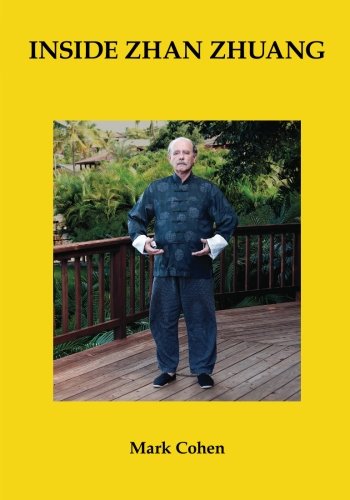
by Mark Cohen

Author of Inside Zhan Zhuang (2013).

(Can not embed these videos. 12 minutes total running time.)

The Nuts and Bolts of Standing Meditation.

Part 1 continues with the basic alignments and body mechanics, opening the midriff to stretch the spine, finding your center from the back, feeling the five points, the low Dan Tien and Mingmen, explanation of the Kua, the biggest "joint" in the body, connecting the lines of gravity - front, back outside and inside.

Part 2  summarizes, reviews and continues with the basic components of the Wuji posture, position of the legs, unlocking the knees, using gravity to release blockages, explanation of SUNG, the body's ideal state. Surrendering to gravity - dropping the weight below the feet, the two types of muscles - mobilizers and stabilizers.

Part 3  concludes with the breath - half-moon and whole-body breathing, the chi breathing point, the Psoas muscles and the hanging basket - suspending the pelvis, closing technique for ending each practice session, how to apply what you've learned and what to expect as you explore the Wuji standing meditation practice.

Wednesday, March 16, 2011

Kata Application Evaluation Checklist: Principles

To evaluate a potential kata application, check the items that apply.


  1. More than one proper interpretation exists.


  2. Every technique should be able to immediately end the fight.


  3. Strike to disrupt; disrupt to strike.


  4. Nerve strikes are "extra credit".


  5. Work with the adrenaline rush, not against it.


  6. Techniques must work at full speed and power.


  7. Application must work on an "unwilling" partner.


  8. Understand why it works.


  9. Deception is not real.


  10. If you are not there, you cannot get hit.


  11. Cross the T to escape.


  12. Stances aren't just for kata.


  13. Don't forget to breathe.


  14. Use both hands.


  15. A lock or hold is not a primary fighting technique.


Use this checklist to decide if a kata is golden or possibly sub-optimal. A sub-optimal evaluation might indicate that you have not been taught the "real" kata. See also the other two parts of this Checklist; Rules and Other Considerations.


From The Way of Kata: A Comprehensive Guide for Deciphering Martial Applications by Lawrence A. Kane and Kris Wilder (2005).

Kata Application Evaluation Checklist: Rules

To evaluate a potential kata application, check the items that apply.


  1. Do not be deceived by the embusen rule.

  2. Advancing techniques simply attack, while retreating techniques imply defense.

  3. There is only one enemy at a time.

  4. Every movement in kata has martial meaning/significance.

  5. A hand returning to chamber usually has something in it.

  6. Utilize the shortest distance to your opponent.

  7. Control an opponent's head and you control the opponent.

  8. There is no "block".

  9. Kata demonstrate the proper angles.

  10. Touching your own body in kata indicates touching your opponent.

  11. Contour the body—strike hard to soft and soft to hard.

  12. There is no pause.


  13. Use this checklist to decide if a kata is golden or possibly sub-optimal. A sub-optimal evaluation might indicate that you have not been taught the "real" kata. See also the other two parts of this Checklist; Principles and Other Considerations.


From The Way of Kata: A Comprehensive Guide for Deciphering Martial Applications by Lawrence A. Kane and Kris Wilder (2005).

Kata Application Evaluation Checklist: Other Considerations

To evaluate a potential kata application, check the items that apply.


  1. Consistent with style's strategy.


  2. Built on natural physiological reaction.


  3. Use this checklist to decide if a kata is golden or possibly sub-optimal. A sub-optimal evaluation might indicate that you have not been taught the "real" kata. See also the other two parts of this Checklist; Principles and Rules.


From The Way of Kata: A Comprehensive Guide for Deciphering Martial Applications by Lawrence A. Kane and Kris Wilder (2005).

Tuesday, March 15, 2011

Permission

From Sensei to Student.

  • You have permission to defend yourself.
  • You have permission to be rude.
  • You have permission to survive, no matter what it takes.
  • You have permission to act when the scary man reaches for his belt. You do not need to wait until he draws the weapon or until he points it at your, or until he hurts you. You have permission to beat me, even it I wear a black belt.
  • You have permission to become better than the best instructor you ever had.
  • You have permission to invent something better than I ever taught you, permission to use it in my class, permission to use it to defeat me, and permission to teach it to your students.
  • You have blanket permission to grow and live and survive and fight and run and scream and talk and play and laugh and learn and experiment and sing and dance. You have permission to win, and you have permission to decide what winning is.
  • You have permission to act.
  • You have permission to be amazing!


Adapted from Rory Miller's Meditations on Violence: A comparison of Martial Arts Training & Real World Violence, 2008.

Friday, March 11, 2011

On Kata - Learn to Move

Excerpt from Rory Miller's Meditations on Violence: A comparison of Martial Arts Training & Real World Violence, 2008.
To me, it looks like kata is all about hands, shoulders, and hips working together simultaneously with a drop in center of gravity (COG). This is one of the most potent systems of power generation. This is a potent system regardless of whether the action is interpreted as a strike, a lock, or a throw.


The more possibilities you see in anything, the more options you have. Since the actions can be interpreted effectively in so many ways, kata may be more powerful as a training tool if you see none of those (or all of them) than if you decide it is just one of them. As long as the hips, hands, shoulders, and COG work together, there is no difference anyway. Karateka get in their own way when they try to dig into the "deeper secrets" of their movement. Learn to move. Kata is excellent for that. Then reproduce or experience the dynamics of actual conflict and you will see how much really valid technique there is in the old forms.


"Kata is to be done in an air of distrust."—Shuzaku Shitama, 16th dai-shihan of Sosuishitsu-ryu

Sunday, December 5, 2010

Karate in YOUNG JUNIUS

What follows is an insightful description of the mind of a beginning Karate/Kung Fu student, excerpt from Chapter 30 of YOUNG JUNIUS by Seth Harwood.
He stepped to that side of the roof and launched into his first form, the punch combination that started off the Monkey Sequence. The Monkey was familiar to him but to get to the next level he had to learn the Tiger perfectly so he could test for his purple belt. Purple marked the turning point between know-nothing beginner and respectable mid-level student. He’d been going for close to three months now and was eager to make the jump.


Purple was a dark color, so different from yellow, white, or orange. Just the fact that you had a dark color around your midsection made you look like you were on your way. Dark belts were real.


The Monkey started with a series of punches and then slide-steps with blocks that led to kicks. As Rough started into these, he gradually left his thoughts behind. As he went on, he started to punch harder, kick with more force. His body loosened up.


In ten minutes, he had his jacket off and was practicing the opening of Tiger. It felt good to sweat in the cold wind, to move faster than when he started, to go through the Monkey as fast as he could.


Now just the start of Tiger was his challenge: to go through it clean and as fast as he could. It was just seven punches, four blocks, and three kicks, with steps and changes of direction in between, but it made for enough of a challenge. He ran through the sequence in his head: punches, blocks, kicks.


I am reading this book on my Kindle and thoroughly enjoying it. (I think the published book is significantly better than the original podcast draft, much tighter story and cleaner descriptions of the world these people live in.) Recommend the book if you like action fiction and enjoyed The Wire series. This book is not for your minivan, so put on your headphones or read the printed word.

The podcast of the story, printed book and/or eBook versions available at all the usual places and at SethHarwood.com.

Sunday, October 18, 2009

Hanbo

Prof. Hager taught the Hanbo class at the AJJF Black Belt Convention this weekend. Several times she referred to the new book by Masaaki Hatsumi, Advanced Stick Fighting (2005). This is a follow on book to the one I am familiar with, Stick Fighting: Techniques of Self-Defense (1981).


Grip the stick with the finger without using the thumb. That way when you open your fist you retain the stick. :)


Think about and apply Kihon No Danzan Ryu in each art.

Work all the techniques, even the ones that you don't like or can't do.

Sunday, July 8, 2007

Ginchin Funakoshi's Rules

Master Ginchin Funakoshi
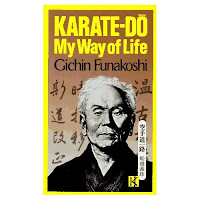
In the book Karate-Do: My Way Of LifeKarate-Do: My Way Of Life by Gichin Funakoshi (1975) there is a chapter called Important Points; Six Rules.


He lists them 1, 2, 4, 5, and 6. The editor acknowledges that Master Funakoshi didn't include a rule #3, it was unaccountable missing. Researching these rules I discovered a book of his on The Twenty Guiding Principles of Karate-Do Buy the book. as well as a website dedicated to him with a not dissimilar list of unnumbered rules.


Here is my compilation of Ginchin Funakoshi's Rules for Karate-Do.

1. You must be deadly serious in training.

"Since karate is a martial art, you must practice with the utmost seriousness from the very beginning."

2. Train with both heart and soul without worrying about theory.

"Try to do exactly as you are taught without complaining or quibbling."

"When you are learning a new technique, practice it
wholeheartedly until you truly understand it."

4. Avoid self-conceit and dogmatism.

"Don't pretend to be a great master and don't try to show off your strength."

"Remember that you must always have a deep regard for courtesy, and you must be respectful and obedient toward your seniors."

5. Try to see yourself as you truly are and try to adopt what is meritorious in the work of others.

"You must ignore the bad and adopt the good."

6. Abide by the rules of ethics in your daily life, whether in public or private.

"Think of everyday life as karate training."


Check out this YouTube slideshow of Ginchi Funakoshi and Shotokan Karate-Do.

Thursday, July 5, 2007

Karate-Do: My Way Of Life


Karate-Do: My Way Of Life by Gichin Funakoshi (1975). This is an autobiographical book written by the man generally credited with exposing Japan and the world to Karate-Do, an Okinawain martial art.


The book reads as if you are politely listing to an old man reminiscing about his life, the things he believes are significant. At times I felt that a good editor would have made for a better story structure. Obviously Master Funakoshi is a proud man of exemplary character who has changed the world for the better. I would like to read a biography about him where the context and impact of his actions are illustrated. I imagine that much of what he did naturally had profound impact on his students and the community. However, as we can never know the extent of our own influence it requires a third person to observe and report.


The Karate book I read before this (The Weaponless Warriors) was a history of many karateka that told great stories of challenges, fights and self defense. It gave me the impression that Karate was primarily a fighting art. But Gichin Funakoshi didn't get into any significant scraps, as a mature martial artist he focused on kata and teaching. I suspect that by taking the danger/injury out of the martial art and focusing on the health and defensive nature you broaden the market (most people don't want to get hurt). Thus the domestication of Karate-Do is what, at least in part, led to its rapid assimilation around the world during Funakoshi's lifetime.


One of the passages that was particularly profound to me was a quote from his first book published in 1922, Ryukyu Kempo: Karate.

"Deep within the shadows of human culture lurk seeds of destruction, just as rain and thunder follow in the wake of fair weather. History is the story of the rise and fall of nations. Change is the order of heaven and earth; the sword and the pen are as inseparable as the two wheels of a cart. Thus, a man must encompass both fields if he is to be considered a man of accomplishment. If he is overly complacent, trusting that the fair weather will last forever, he will one day be caught off guard by terrible floods and storms. So it is essential for all of us to prepare each day for any unexpected emergency.


"... Today we are enjoying peace, and our country is making great strides forward in every field. Swords and lances, now virtually useless, have been stored away in our cupboards. But now the subtle art of self-defense called karate grows increasingly popular, and people have asked me time and again whether there is not some good reference book available."


The sword and pen are equally strong.

Monday, May 21, 2007

Kata in Karate Practice

I am reading the book The Weaponless Warriors; An Informal History of Okinawan Karate by Richard Kim. It is a collection of short articles on the historical figures of Okinawan Karate.


Itosu Yasutsune
To quote the book, page 58, "Today, Itosu is remembered mainly through his kata. His concentration during his teaching years centered around fulfillment of each person's individual physique. He realized that each person had to develop his body to the highest possible perfection, for himself and for his purpose. To put the body under complete control of the mind was necessary before any other type of development could take place. Itosu knew that kata was best for this."

Karate is a way of life, a means to achieve complete security and fearlessness.


Kyan Chotoku
Kyan practiced the seisan for two years to perfect it. Seisan was the first kata taught by Okinawan masters prior to 1903. Today still clings to this tradition including Tatsuo Shimabukuro's lineage (whom studied under Kyan). The incessant drill and pedantic attention to detail required for mastery of a kata made a profound impression on him.


Men three times younger than you can not move you at all, "What is it?"

Develop your tanden. Drop your mind there and operate all your actions from there. Practice your kata until your kata moves from your tanden. When you become the kata, you have achieved the secret.

Friday, April 13, 2007

Karate Training to Begin

Yesterday I had the interview with Kyoshi Dave Joslin. I told him about myself and why I wanted to train at his school. He was comfortable with what I had to say and believes that I will feel at home in the dojo.


I signed up for a ten months of classes, Monday and Wednesday evenings beginners. My first class will be April 16, 2007 with Mr. Oliver.


I came home with a light weight white gi, size 6, and a pair of bag gloves.


They were out of the book that they recommend for beginners. But it was nice to see The Bubishi for sale along with all the other books. I'm going to reread it. ;)