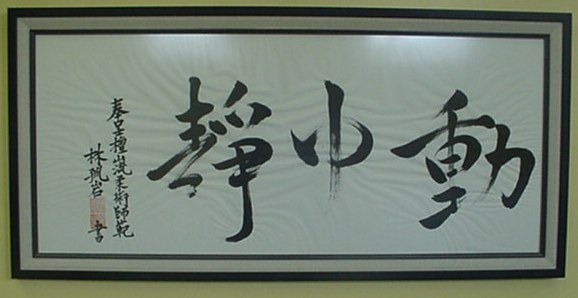
A year ago was my first promotion in Isshinryu Karate. Yesterday I took to camera to the dojo to record pictures of Mr. Oliver, our teacher, Ms. Bloom and myself. Ms. Bloom and are climbing the ranks together. She is a shining example of someone following the principle taught at Joslin's East/West Karate.
I was just getting use to the physical conditioning (push-ups and sit-ups) when we go and get promoted out of the beginner class. There is a 50% increase in the number of conditioning exercises in the advanced classes. Ouh, ouh, ouh being it on!
This kata is of Shuri-te (Shorinryu) origin, the third kata taught at our dojo. The name means Iron Horse. Alternate meanings of the name are surreptitious steps, sideways fighting, and horse riding straddle stance.
The kata has 67 moves, against 4-8 attackers from the front and sides. Naihanchi Kata is easily recognized by the fact that all movements are on the lateral line, staying on a straight track as if against the edge of a cliff or wall. It takes 35 seconds to execute.
Here is an old film (1966) of Master Tatsuo Shimabuku performing the kata, 1966.
Joslin's East West Karate—Naihanchi Kata Facts
What is the nickname for the Naihanchi Stance? Iron Horse Stance What type of attacker are we defending against? Chinese Martial Artist What is this kata known for? Lateral movement What part of the body is being developed? Lower body In the Naihanchi stance the toes are pointed inward (pigeon-toed), how many degrees? Ten Traditionally where might you be defending yourself? Rice paddy, foot-bridge or with back against the wall
This kata is of Goju Ryu origin, Master Miyagi, the second kata taught at our dojo. The name means War Kata. It may also be translated as the storm within the calm or the lull in the storm.
The kata has 126 moves, against 6 attackers but contains no kicks. It takes 55 seconds to execute.
The kata begins slowly with power and ibuki breathing from a horse stance. The floor pattern is a Y for the most part. After the intense opening the kata explodes into a full power fast kata.
Here is an old film (1966) of Master Tatsuo Shimabuku performing the kata.
This week I tested for my next rank, Green Belt. Master Dave Joslin watched Ms. Bloom and I practicing the kata (we though we were practicing) and told Mr. Rypma to complete the paperwork for green.
As a green belt I now attend the intermediate classes with other green belts and the purple belts. The calisthenics are increased by 50% over the beginning classes.
Koyshi Dave Joslin talked about creating openings this evening. What is open now will be closed down by the time you get there so plan on going somewhere else. One must commit to an attack before uki will commit to the defense then you may choose a different target.
Most people, non-skilled fighters, block and guard with one hand only. Very easy to get them to commit and leave an opening.
There are three gates to the body; jodan, chudan, gedan. You can keep one or maybe two covered (closed) but it is unlikely that all three will be closed all the time. There is always a target of opportunity.
He started the lesson with a demonstration of Kiai Dori.
I competed in the West Coast Karate Classic 2008 today, my first Karate competition. (Held in the gym of Placer High School just down the street.)
It started with all the adult blackbelts doing Kata (forms) which took about two hours to get organized and executed. Then they did all the kids.
I competed in the Intermediate 35+ male Forms and Intermediate 35+ male Sparring contests. Technically I should have been in the Beginners section but I didn't feel right competing with guys with less then one year experience.
First we did the Forms where I performed Seisan Kata. There was a tie for third place so Dan and I had to perform our katas a second time. Dan placed third, I was forth.
As soon as all the guys demonstrate their forms the awards were handed out and the Sparing competition started on the same mat. In this event I also placed forth. I don't understand how that happened as I did win either of my two rounds.
The sparing rules are to pause the fight as soon as one of the competitors scores a point. The match is paused before a counter can be launched. Many of the people who "know how it is done" drop their guard and turn their back on the opponent as soon as they touch them or they are touched. This one guy actually jumps up and vaults in head first with his fist extended to score a point; it looks silly and leaves him off balance and open to all kinds of counter punches and kicks (that are not allowed under the rules.)
The concept of Shu-Ha-Ri was introduced in a software testing discussion group today. An engineer at work had questions about becoming a black belt and the promotion process. The Aikido FAQ: Shu Ha Ri
In this, I think we see an enormous difference between how people best learn skills that are primarily physical versus skills that are primarily cognitive. I think there is a good argument to be made that highly skilled martial arts are intensely cognitive, but there is also a very significant physical-skill aspect that is not present in software testing, mathematics, etc. Thus, training juniors in a way that works well for developing physical skills might be productive for martial arts and unproductive for mathematics (or software testing), even though the mental skills needed for MASTERY of either field might be equally sophisticated and complex. -- Cem Kaner