Tuesday, December 7, 2010

Indomitable Spirit

Tamashii—Indomitable Spirit


Merriam-Webster definition; incapable of being subdued : unconquerable.


Im my dojo indomitable spirit is much more than a "can do" attidude. More then "Never surrender, never say die." or "Never give up, never surrender! ". It is a commitment to personal excellence and fortitude in everything we do.


Old Japanese saying, Nana-korobi, ya-oki. This means fall down seven times, get up eight.


The concept of One Encounter, One Chance, is part of the Japanese milieu that includes Tamashii. Do it the first time, there is no second place in a duel.

Sunday, December 5, 2010

Karate in YOUNG JUNIUS

What follows is an insightful description of the mind of a beginning Karate/Kung Fu student, excerpt from Chapter 30 of YOUNG JUNIUS by Seth Harwood.
He stepped to that side of the roof and launched into his first form, the punch combination that started off the Monkey Sequence. The Monkey was familiar to him but to get to the next level he had to learn the Tiger perfectly so he could test for his purple belt. Purple marked the turning point between know-nothing beginner and respectable mid-level student. He’d been going for close to three months now and was eager to make the jump.


Purple was a dark color, so different from yellow, white, or orange. Just the fact that you had a dark color around your midsection made you look like you were on your way. Dark belts were real.


The Monkey started with a series of punches and then slide-steps with blocks that led to kicks. As Rough started into these, he gradually left his thoughts behind. As he went on, he started to punch harder, kick with more force. His body loosened up.


In ten minutes, he had his jacket off and was practicing the opening of Tiger. It felt good to sweat in the cold wind, to move faster than when he started, to go through the Monkey as fast as he could.


Now just the start of Tiger was his challenge: to go through it clean and as fast as he could. It was just seven punches, four blocks, and three kicks, with steps and changes of direction in between, but it made for enough of a challenge. He ran through the sequence in his head: punches, blocks, kicks.


I am reading this book on my Kindle and thoroughly enjoying it. (I think the published book is significantly better than the original podcast draft, much tighter story and cleaner descriptions of the world these people live in.) Recommend the book if you like action fiction and enjoyed The Wire series. This book is not for your minivan, so put on your headphones or read the printed word.

The podcast of the story, printed book and/or eBook versions available at all the usual places and at SethHarwood.com.

Tuesday, November 9, 2010

Naihanchi Kata - Details

The Japanese Martial Arts Character Dictionary by Prof. Thomas R. Jenkins says that "naihanchin" is the Okinawan word for the Japanese word "naihansen", fighting on a levee.


Other Japanese words that seem applicable based on their kanji are:

  • Naihan—on a levee
  • Nai—inside (first kanji in naihansen)

Monday, November 1, 2010

Nose Bleeds and Hanaji Tome

A recent podcast by the House Call Doctor's, When Should You Worry About A Nosebleed, prompted me to post this response. I want to add the new (to me) information gleaned from Dr. Rob's podcast.

Hanaji Tome—nose bleed stop resuscitation—is from the Kappo list of Danzan Ryu Jujitsu. The following is my take on Hanaji Tome and mine alone, all errors, misinterpretations and/or bogusness is mine and should in no way reflect upon of my teachers.

First of all let me say that all the wonderful Jujitsu recession technique do work and do fail to work, I've see it myself. Stopping a bleed is particularly difficult when the patient is taking blood thinners (anti-coagulants) like baby aspirin.Many health conscious martial artists over 40 years of age self medicate with aspirin but then again they don't seem to get punched in the nose very often.

Although a nose bleed is not life threatening to the patient the risk of blood born pathogens must be considered with helping someone. Any time you may come in contact with someone else's blood the use of personal protective equipment (PPE) is strongly encouraged.

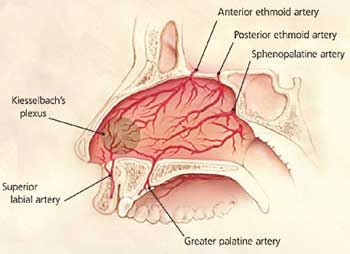
Anterior nose bleed is what we see on the playground and in the dojo, from the Kesselbach's plexus. Posterior nose bleeds, the other type, are very serious that generally require hospitalization/surgery.

Dr. Rob's 5 tips for Dealing with a Nosebleed.
  1. Don't Panic
  2. Blow your nose
  3. Use a decongestant nasal spray
  4. Hold the nose
  5. Insert cotton and apply ice to the bridge of the nose

Saturday, October 30, 2010

Camp Kodenkan South, 2010

Aloha Sensei, black belts and alumni campers!

We are yet again at the point of announcing Camp South with pleasure 2010! This year we will be at Camp Fox in the San Diego mountains. We will have exams on Friday and our usual class schedule and events over the full weekend.

I wish this year to extend a welcome to those who have not yet attended camp before or to those with whom it has been some time. We all have so many demands on our time and money these days, we within the AJJF, tend to pick our favorites and miss other wonderful events available to us. I remember the times when a few events a year was all there was! But those days are gone and I for one am very happy with all the possibilities open to us within the AJJF DZR experience.

Nevertheless, we hope for those who have not come might consider this year attend camp. For those who come yearly we thank you and look forward to seeing you this year as well!
Camp offers 6 meals, sleeping quarters and all the classes at one location. This year the fee will be the same as last year, that being: $180.00! This is 6 meals, room and all classes. We also will transport those who come in by plane at the San Diego airport to and fro.

There will be an email coming soon giving all the details about camp and who is teaching, classes, etc. But for now, let me announce the weekend it falls on each year is the first weekend of December. This year that will be Friday the 3rd, Saturday the 4th and Sunday the 5th.

Hope you will consider camp in your choices this year, we know you will enjoy it to the max! I'll write soon with more info but in the meantime feel free to write or call me At;

480-686-6118
RHudson602@aol.com

Regards,

Professor Robert Hudson
________________________________
November 1, 2010
Aloha Sensei and black belters


As promised here is the second letter regarding camp this year. As mentioned in my previous email, we will be hosting Camp South December 3,4,5,2010. This year will be at Camp Fox.

The fee this year is the same as last year which includes six meals, 2 nights room and all training. The fee is $180.00. Also, if you need a ride from the airport we can arrange for that. This years theme is Ho Omana...This means to develop and recognize your innate capacity to attain whatever you set your mind and body toward. That the way we train determines the extent of our success. We hope then to offer instructors insights as to how they have attained what they have and what personal methods they have used alongside their DZR training to get there.

Please go to ProfHudson.com to get the application form. It will ask you pertinent questions for us to help you get to camp and take care of any special needs you may have. It will give you location, times and where to send your fees to.

Please do everything you can to get your registration in as soon as possible and if you have any concerns please email me to discuss.

My email address is

Rhudson602@aol.com

Or you can call me at

480-686-6118

Looking forward to seeing you there! Also, I offer my full support and best
wishes for those taking their black belt exams at camp. It will be a great place
and way for you to take such an exam. Best of luck!


Sincerely,

Professor Bob Hudson

Saturday, October 16, 2010

Catch A Punch

If you can catch a baseball you can catch a punch.

—Hanshi Willie Adams

Centering

This entry on Centering was created because I realized that when Grand Master Willie Adams used the term he meant something completely different from what I think of when I hear the term Center.


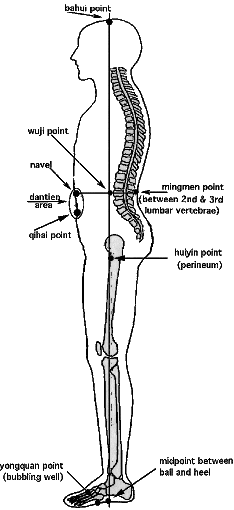
When I talk about center I mean the center of the physical body, the wuji point (click on figure for more information) and connection to the ground. When Hanshi speaks of centering he is speaking of remaining on the center line of attack, not tipping or swaying from side to as you move. The following is what I learned from Hanshi Willie Adams at his seminar down at the dojo last month. (Yes, I wrote things down after the seminar and have been working with the concepts on the mat.) This is my understanding of centering. (The seminar was public and very basic. I can only imagine the significance of centering in Hanshi Adams teachings.)

Centering = Step + Set

  1. Weight distributed equally between the two feet. Weight on the balls of the feet.
  2. Head stays on the center line, the line of attack, during a step.
  3. 10% weight shift during a step.
  4. Ball of foot skims the ground, toes up.
  5. During circle step the leg movement covers the groin (45° angle.)
  6. Weight shifts back to 50/50 before the set (stepping foot plants.)
This circle step with centering is not unlike the Archer Step we do in Yiquan.


After digesting the principal of centering and incorporating it with another of Hanshi's ideas, "throwing" a punch/kick, I realized that Isshinryu Karate is primarily a linear system. It gets its speed and effectiveness from direct shortest–distance movements.

Direct force—swiftly applied.